
“Trust Me, I’m an Expert,” and Other Fallacies in the Consulting World
- Emily VanderWey
- 3 days ago
- 9 min read
Best Practices for Hiring Consulting Firms: Insights from Both Sides of the Engagement Table
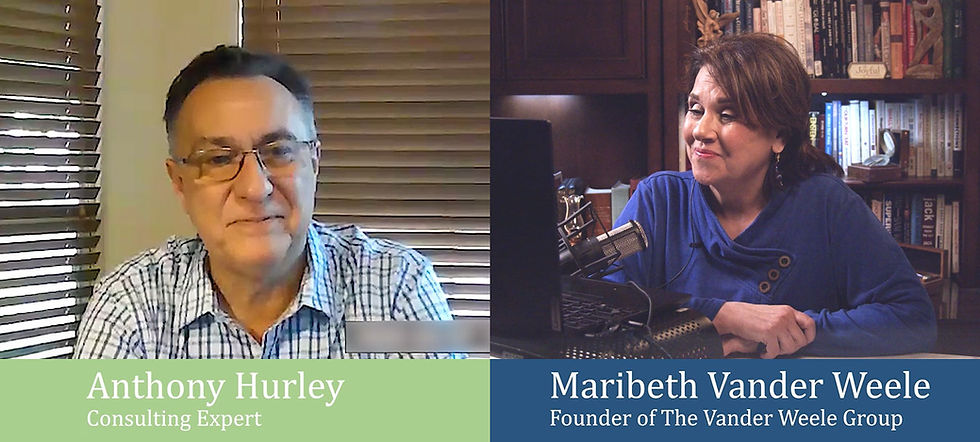
Maribeth Vander Weele wasn’t always a consultant; for much of her career, she was the one who had to live with their results. As a former Inspector General, Maribeth knows what it’s like to sit on the buyer’s side of the table, mastering the often-painful lessons of how to effectively vet, hire, and manage external firms. She learned the hard way that while the right consultants can be transformative—capable of quintupling a business—the wrong ones can be arrogant, underqualified, or unjustifiably expensive.
Knowing how to hire well can be the difference between a successful project and a costly failure. Success, of course, is a two-way street. Maribeth notes that clients can bring their own hurdles to the table, such as unrealistic timelines, an unclear vision, or constantly changing demands.
To help other leaders navigate these complexities, Maribeth sat down with Anthony Hurley, a seasoned consultant and former Vice President of one of New Jersey’s largest utility companies. Having been on both sides of the table, Anthony and Maribeth offer a 360-degree perspective on how to get the most out of a consulting partnership as a government program officer.
Strategic Planning
Build Partnerships Before the Crisis Hits
The ideal time to hire a consulting firm is when you identify a strategic need but lack the internal expertise to address it—whether you are building a new process, implementing technology, or navigating complex new regulations. Conversely, the wrong time to hire is in the wake of a disaster.
Bringing in an outside firm while your organization is already in turmoil puts an exhaustion tax on your staff, who must then onboard consultants while simultaneously managing a crisis. Don’t wait for a high-stakes emergency to begin your vetting process. Instead, establish long-term relationships during stable periods; by doing the groundwork early, you ensure that trusted experts are ready to mobilize the moment a challenge arises.
Define Your Goal: Capacity, Capability, and the Roadmap to Success
Know what your goals are for hiring a professional services firm. Determine if you are hiring for Capacity (extra hands to execute work your team understands but lacks the time to do) or Capability (specialized, high-level knowledge that does not currently exist within your organization). Often, a project requires a strategic combination of both. Equating one with the other is a costly mistake—it leads to either overpaying for simple tasks or under-equipping complex ones.
You cannot plan for success if you haven't defined it from the start. Whether you develop the project plan independently or with a consultant’s help, a lack of clear direction is the primary reason projects suffer. While flexibility is necessary for unexpected delays, ambiguity invites scope creep, giving consultants an opening to expand the project unnecessarily. By establishing concrete milestones and measurable outcomes at the outset, you ensure the project remains focused on achieving the original goals.
Know Your Budget and Return on Investment
While government agencies are often tethered to the lowest bidder, savvy leaders weigh the upfront cost against the expected Return on Investment (ROI). A cheap contract that fails to deliver is more expensive than a premium one that solves the problem.
To account for this in the procurement process, ensure your RFP scoring criteria prioritize technical merit and past performance over price alone. By utilizing a best value evaluation rather than a lowest price model, you can justify selecting a firm with higher-caliber practitioners who will complete the project correctly the first time.
Vetting for Expertise and Integrity
"Take the time to do the vetting, the interviews, and ask the right questions. Make sure that when you sign that contract, you are getting the expertise you need and have a reputable organization to work with."
— Anthony Hurley
Prevent the "Bait-and-Switch" in the RFP Process
"A firm is just a corporation; that’s all it is. It’s really the consultants, their expertise, and their backgrounds that will take your project from failure to success."
— Anthony Hurley
A common consulting tactic involves presenting highly qualified people during the proposal phase, only to staff the actual project with lower qualified people once the ink is dry. To protect your investment, you must audit the resumes to verify that the staff assigned to your project actually possess the technical expertise claimed. Maribeth and Anthony emphasize the importance of locking in your team by ensuring the contract specifies that named experts cannot be replaced without your explicit written approval. While some flexibility is necessary—Maribeth and Anthony discussed that there are times when the original proposed staff may not be available by the time an engagement begins due to delays outside their control—you must insist on an open line of communication and the right to approve any staffing changes before and during execution.
Another common tactic to watch for involves prime contractors who leverage the unique certifications and expertise of smaller, niche firms to win a bid, only to bypass those subcontractors once the contract is secured. Both Maribeth and Anthony have seen this play out firsthand. To prevent this, verify participation throughout the project to ensure specialized subcontractors are doing the heavy lifting they were hired for. One effective way to enforce this is to introduce contract penalties if the subcontractor does not receive the specific percentage of the project established in the proposal. This ensures that the expertise you saw on paper is the expertise you get on the ground.
Evaluate Process and Team Synergy
As Maribeth Vander Weele notes, the success of an engagement depends not only on individual expertise but on how the team functions as a cohesive unit. "The experience of the consultants is very important, but also how they work together—the project management process, the training, the onboarding, and the effort to truly know the client," she explains. "That is where a good firm brings real value. Process is important."
A high-performing firm provides project managers who are extremely clear about task assignments, ensuring that every team member understands their specific role. There is no room for game-playing or internal competition to carve work away from other consultants; instead, you should look for firms that demonstrate a seamless, collaborative culture. To identify these qualities during the procurement phase, you must inspect the firm's project management processes. The RFP should require the firm to specify exactly how they coordinate tasks, manage internal hand-offs, and maintain deliverables. A firm with high synergy will provide a clear, disciplined methodology.
Furthermore, evaluate the team's history as a unit. A group of strangers assembled from disparate departments is a major red flag for internal friction. During interviews, observe the team’s dynamics closely. Listen for a group that speaks in terms of integrated workflows ("we") rather than individual heroics ("I"), and look for a project manager who can define who will take responsibility for each deliverable. By prioritizing teams with a proven, collective process, you ensure the focus remains entirely on delivering results rather than navigating consultant dysfunction.
Prioritize Multidisciplinary Teams of Practitioners
As Maribeth emphasizes, the most effective engagements avoid a one-size-fits-all approach. You don’t want a team comprised entirely of accountants, or construction folks or utilities experts; you want a combination because success requires a strategic combination of diverse skill sets. Beyond technical credentials, it is essential to have practitioners on the team—individuals who have worked within the industry and understand its unique operational nuances. By pairing deep, boots-on-the-ground experience with specialized expertise and a multidisciplinary perspective, you ensure the team can navigate complex challenges and lead the project to a successful, high-impact conclusion.
Partner with Firms That Demonstrate Commitment to Integrity
In the consulting world, a global brand name is often used as a shield, but as Maribeth notes, it is rarely a guarantee of quality. She recalls an engagement where a Fortune 500 company hired a large firm that deployed a massive team of inexperienced juniors who held up the project by forgetting basic equipment while everyone continued to bill for their time. In one instance, that firm billed for four or five high-priced professionals to go through a PowerPoint deck line by line, rather than having a designated individual coordinate edits and reviews. Ultimately, the Vander Weele Group produced the substantive work for the project, while the larger firm—charging ten times more—delivered only a PowerPoint presentation.
This lack of professional accountability can take even more extreme forms; Maribeth recalls another instance where a client required surprise drug testing for an audit team working in a secured area, resulting in one-third of the consultants being removed from the building immediately. These stories highlight a hard truth: brand prestige does not equal substance. When vetting a partner, it is essential to look for consultants who own their mistakes and maintain a clean regulatory history. Doing your own due diligence is vital to ensure a firm hasn't been involved in pay-to-play scandals or significant ethical settlements.
As both Maribeth and Anthony stress, an absolute commitment to ethics is the foundation of a partnership that serves the public good. A high-integrity consultant will tell you if your timeline is unrealistic or if your plan has a fatal flaw—even if it risks the contract. For leaders who care about the success of their programs, it is essential to partner with a firm that values its reputation and your mission more than its next invoice.
Executing for Results: Navigating the Red Flags
Selecting the right firm is only half the battle; the other half is managing the engagement to ensure you get exactly what you paid for. By staying vigilant during the project lifecycle, you can spot warning signs early enough to recover. Maribeth and Anthony discussed some of the tricks consulting firms play to milk a contract:
Watch Out for Scope Creep
In some cases, a firm may claim they cannot solve the problem they were hired for until a series of other, newly identified issues are addressed first. As Anthony points out, there are times when this is absolutely true, and he has been in that situation himself. However, the key for a program manager is to distinguish between a legitimate technical dependency and a tactical deflection designed to prolong the engagement.
Watch for the Never-Ending Questions
Beware of consultants who use endless inquiries to postpone the actual work. While gathering information is a legitimate part of the process, it can also be a calculated move to inflate a contract. Maribeth notes that some firms pretend they lack sufficient information to move forward, using it as a tactic to delay producing deliverables while continuing to bill for meetings and meaningless dialogue. These deflections—ranging from blaming a lack of documentation to complaining about missing marketing materials—are designed to shift the fault from the firm to the client. Ultimately, if a consultant spends more time talking about the work than actually executing it, they are stalling the project’s momentum at your expense.
Enforce the Fundamentals
Successful project management ultimately relies on enforcing the basics. You must hold consultants accountable to the original terms of the engagement without accepting excuses for poor performance. As Anthony advises, "Make sure you're managing the basics. If you set a date, a dollar amount, and timelines for updates, make sure your expectations are met." By refusing to accept vague justifications for missed milestones, you ensure one of two outcomes: either the project stays on track, or you realize early on that the firm cannot deliver. Identifying a failure early provides the best chance to cut your losses and recover your program’s momentum.
However, there is a distinct difference between a stall and a genuine commitment to quality. Anthony recalls a consultant who expressed deep distress over a deadline because the task was more complex than anticipated. Instead of deflecting, she was transparent about the challenge. This honesty revealed a level of integrity that Anthony respected. Because she came forward early and earnestly, they were able to modify the plan, leading to a superior end result. The key lesson for leaders is to value the partner who is honest about the hurdles, but to be wary of the one who has a list of never-ending excuses.
The Final Standard: Turning Expense into Investment
A successful consulting engagement ends when the client sees a clear, measurable improvement. By solidifying the plan, vetting for expertise and integrity, and enforcing the fundamentals, leaders ensure that every dollar spent on professional services is a strategic investment in the people they serve. To solidify these gains, always conduct a postmortem to evaluate the engagement honestly. If a firm failed to provide a clear ROI, they should not earn the right to repeat business.
Partner with the Vander Weele Group
By choosing a partner like the Vander Weele Group that values your mission as much as its own reputation, you transform professional services into a powerful tool for the public good. We bring to the table a multi-disciplinary team of practitioners run by an individual whose life’s work has been centered on promoting integrity in large organizations.
“In the grants monitoring business, we don’t just want to say we ensured compliance; we want to say we brought value. We gave a return on investment—we either secured recoveries, or we re-engineered processes that made the program much more effective and served the people for whom it was designed. That’s very exciting work.”
— Maribeth Vander Weele, Founder
Call us today at 773-929-3030 to discuss how we can support your mission.



Comments